
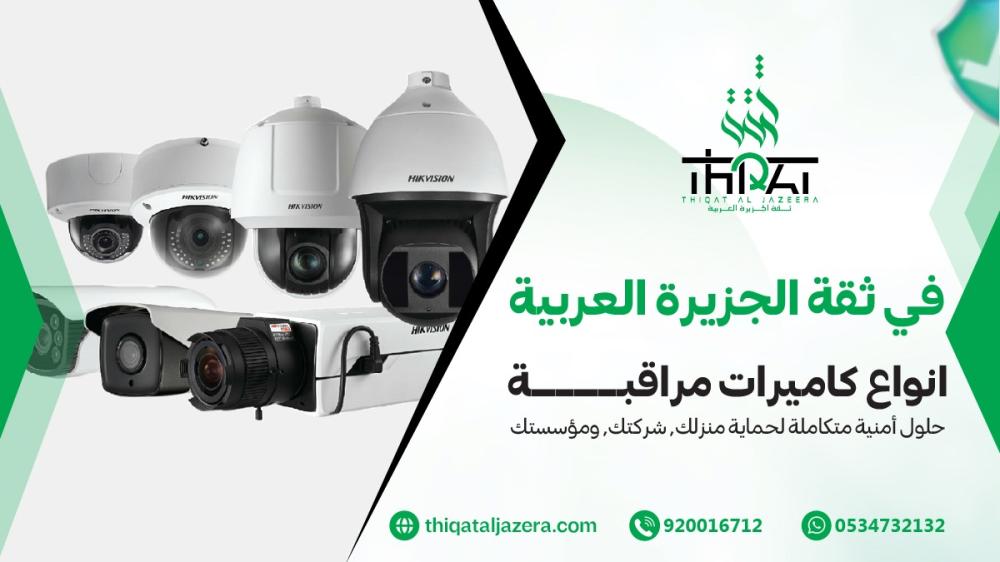

Types of surveillance cameras: Your guide to choosing the perfect security system
In today's world, surveillance systems have become an essential part of protecting homes, businesses, and public facilities. With the increasing need for security and continuous monitoring, many people struggle to choose the right type of surveillance camera . In this article , Al Jazeera Security Systems provides a comprehensive guide outlining the most prominent types, their features, and how to select the optimal system for your needs.
1. The importance of surveillance cameras
Security cameras are an effective tool for ensuring safety. They not only help monitor events and risks but also contribute to deterring and preventing theft and vandalism. Using appropriate types of security cameras can significantly reduce security risks and provide peace of mind.
Modern security cameras have become an indispensable part of any place that needs protection, whether it's a small home or a large facility. They allow you to monitor every detail and ensure the safety of your property around the clock.
2. Classification of types of surveillance cameras
Security cameras are classified according to the technology used, installation method, and intended use. Key classifications include:
A. According to the technology:
- Analog cameras:
- It works by direct connection to a DVR device.
- Suitable for small homes and offices.
- Its price is relatively low, but it may offer lower image quality compared to modern cameras.
- IP cameras:
- It relies on the digital network and provides high quality HD or 4K.
- It can be accessed remotely via phone or computer.
- Ideal for businesses and smart homes, it allows for accurate recording and tracking of events.
- HD-TVI / HDCVI / AHD cameras:
- Modern technologies combine the features of analog and digital cameras.
- It offers high quality up to 4K, with the possibility of installation over long distances without loss of quality.
- Suitable for those who want to upgrade an old system without changing the wiring completely.
b. According to purpose:
- Indoor cameras:
- Designed for use inside buildings.
- Often small in size and easy to install.
- Continuous monitoring is provided for living rooms, offices, and storage areas.
- Outdoor Cameras:
- Resistant to weather elements such as rain and dust.
- It often includes night vision technology.
- Suitable for monitoring around buildings and parking areas.
- Hidden cameras:
- Designed to be invisible, allowing surveillance without people noticing.
- They are often used for close monitoring or to protect children and staff.
- Military or specialized cameras:
- It is used in sensitive places such as banks, large factories, and vital facilities.
- It features very high image quality, resistance to harsh conditions, and an advanced recording system.
c. According to the installation method:
- Fixed cameras:
- It works by covering a specific area.
- It is cheaper and easier to use.
- Ideal for small rooms and entryways.
- PTZ Cameras:
- The camera movement can be controlled remotely (Pan, Tilt, Zoom).
- It provides wide coverage and can be zoomed in to see fine details.
- Ideal for large companies and vital facilities.
- It can be programmed to automatically track movement when any activity is detected.
- Dome cameras:
- Sleek, round design, often vandal-resistant.
- Suitable for public places, businesses, and hotels.
- It offers a wide-angle view and blends easily with the interior décor.
- Box cameras:
- It offers high image quality and advanced features.
- You need to install a suitable lens for each location.
- It is often used in large areas and for professional surveillance.
Dr. According to night vision:
- IR (Infrared) Cameras:
- Infrared radiation is used to image dark areas.
- It allows 24-hour monitoring without losing any details.
- Useful for entrances and nighttime parking areas.
- Low-light cameras:
- It works more efficiently in dimly lit places.
- It provides clear image quality with low natural lighting.
- Thermal cameras:
- It detects the heat emitted from objects to determine location and movement in darkness or smoke.
- It is often used in industrial and military installations.
3. Advantages of using multiple types of surveillance cameras
Using an integrated system that combines several types of cameras greatly enhances security. Key advantages include:
- Comprehensive coverage: Fixed cameras cover key angles, while mobile cameras cover large areas.
- Advanced night vision: Night vision helps to detect any suspicious activity in the dark.
- Remote access: IP cameras allow monitoring of the building from anywhere via smartphone.
- Professional recording: All cameras can be integrated with DVR or NVR devices for recording and later reviewing video.
- Smart video analysis: Some modern cameras provide smart alerts when motion or unknown people are detected.
- Flexibility in installation and expansion: New cameras can be easily added as needed without having to completely rebuild the system.
4. How to choose the right camera
The choice of camera depends on several factors:
- The area to be monitored:
- For small spaces, fixed cameras may suffice.
- For large areas, PTZ or dome cameras are preferred.
- Environment type:
- Indoor spaces need small, hidden cameras.
- Outdoor locations require weatherproof cameras.
- Required image quality:
- High-resolution cameras (HD or 4K) provide clearer images and finer details.
- If the monitoring is for the purpose of deterrence only, then a lower quality may suffice.
- Remote monitoring capability:
- IP cameras provide this feature excellently.
- Some analog cameras require additional devices for remote access.
- Additional features:
- Night vision, facial recognition, smart alerts.
- Easy to install and maintain.
- Your budget:
- There are options for every price range, but it is preferable to invest in high-quality cameras to provide long-term protection.
5. Tips for installing the best types of surveillance cameras
- Place the cameras in strategic locations that cover all entrances and exits.
- Avoid mounting cameras facing direct light to avoid dark images or glare.
- Use weatherproof cameras for outdoor locations.
- Maintain the cameras regularly to ensure good performance.
- The cameras are integrated with an alert system to provide instant notifications of any abnormal activity.
- Install the cameras at a suitable height to avoid vandalism or tampering.
6. The future of surveillance camera types
With technological advancements, new technologies have emerged in the world of surveillance, such as:
- Smart Cameras: Equipped with artificial intelligence for facial and motion recognition.
- High-quality 4K and megapixel cameras: provide unparalleled clarity.
- Wireless cameras: They make installation easier without the need for complicated wiring.
- Intelligent video analysis: The system can automatically alert you when any suspicious activity occurs.
- Integration with smart homes: Connecting cameras to alarm and lighting systems to provide integrated security.
7. Frequently Asked Questions (FAQ)
Q: What is the difference between analog and IP cameras?
A: Analog cameras rely on direct connection to a DVR and offer lower quality, while IP cameras rely on a digital network and allow remote monitoring and high image quality.
Q: Can surveillance cameras be installed outside the house?
A: Yes, weatherproof cameras with night vision should be chosen to effectively cover outdoor areas.
Q: Are hidden cameras legal?
A: Laws vary by country, but they can often be used inside the home for personal protection purposes, provided that the privacy of others is not violated.
Q: Can I view the cameras on my phone?
A: Yes, most IP cameras offer apps that allow you to view live video and recordings from anywhere.
Q: How do I choose the best camera for a large area?
A: PTZ or Dome cameras are preferred for covering a wide area, and can be combined with fixed cameras to cover precise angles.